If carrying out the reaction in a lab...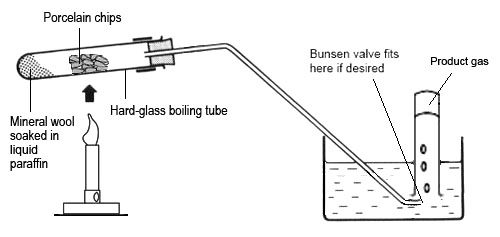 1- Heat the hydrocarbon (e.g. paraffin).
2- After a few seconds, move the Bunsen burner to heat the silica/aluminium catalyst
3- Alternate between the two until the paraffin vaporises and the catalyst glows red
4- The heated paraffin vapour cracks as it passes over the heated catalyst
5- small alkanes collect at the end of the boiling tube, while alkene gases travel down the delivery tube
6- The alkenes are collected through water using a glass jar
1- Heat the hydrocarbon (e.g. paraffin).
2- After a few seconds, move the Bunsen burner to heat the silica/aluminium catalyst
3- Alternate between the two until the paraffin vaporises and the catalyst glows red
4- The heated paraffin vapour cracks as it passes over the heated catalyst
5- small alkanes collect at the end of the boiling tube, while alkene gases travel down the delivery tube
6- The alkenes are collected through water using a glass jar
In industry, vapourised hydrocarbons are passed over a powdered catalyst at about 600-700°C. silica and aluminium are used as catalysts.
Notes credit: CGP
Fractional distillation produces lots of long chain hydrocarbons and not many short chain hydrocarbons in relative. The short chain hydrocarbons are useful but long chain hydrocarbons are not. This means we have to break the long chain hydrocarbons into short chain hydrocarbons as demand for short chain hydrocarbons is high. This is done in a process known as cracking. This process is a form of thermal decomposition, which just means breaking down the molecules into simpler molecules by heating them.
Sulfur dioxide mix with clouds forming dilute sulfuric acid, which is very acidic. Nitrous oxide also mixes with clouds, forming nitric acid. These fall as acid rain which causes lakes to become acid in (killing plants and animals), kills trees and damages limestone buildings and statues.
There have also been links made between acid rain and human health although these are not proven.
In car engines, crude oil fractions (such as diesel or petrol) are burnt (as fuels). When fossil fuels are burnt, nitrogen oxide and sulfur dioxide are always released, always. When the temperature is high enough, the nitrogen and oxygen in the air react (this creates nitrous oxides, such as nitrogen monoxide and nitrogen dioxide).
NOTE: remember nitrogen oxide and sulfur dioxide are always produced when fossil fuels are burnt.
First of all, incomplete combustion just means that the substance/thing was burnt without lots of oxygen present. When hydrocarbon fuels (for example gas or petrol) is burnt without oxygen, carbon monoxide is produced (as apposed to carbon dioxide, with complete combustion). This is bad because carbon monoxide is poisonous. This is because it combines with haemoglobin (this carried oxygen in your blood), preventing as much oxygen to get to your cells (as less oxygen can bind with the haemoglobin as there is lots of carbon monoxide combined with the haemoglobin). Therefore, less oxygen is being carried around your body (in your blood), this can lead to fainting, a coma or even death (in severe circumstances) as your cells are effectively being starved of oxygen.
The lower the boiling point, the lower the viscosity, and vice versa (high boiling point = high viscosity)
NOTE: basically, the lower the viscosity, the thinner the substance runs, the higher the viscosity, the thicker something is (as liquid). For example, water has a super low viscosity, whilst syrup has a higher viscosity than water.
Refinery gases - used in pottery and glass manufacture, heating and bottled gas
Gasoline - used for fuel for cars (its petrol, in other words)
Naphtha - Used as a starting material of making things like plastics,dyes, drugs, explosives and paints (to name a few)
Kerosene - used to fuel jets, in heating and in paint solvents
Diesel - fuel for cars, trucks, trains and boats
Fuel oil - central heating and fuel for really big ships
Bitumen - used to surface roads
NOTE: the process of fractional distillation is mentioned in point 1.7
One use of fractional distillation is separating crude oil into fractions (compounds). Heres how it happens...
- Heat the crude oil until almost all of it has turned into gas, these gases will enter the fractioning column as they evaporate. NOTE: the left over liquid is bitumen, it has a very high boiling temperature so is instead tapped off at the bottom of the column.
- NOTE: in the column there is a temperature gradient. Basically, it is really hot at the bottom and quite bit colder in the top (not actually cold though). This is useful as the substances that make up crude oil have different boiling temperatures, when the substance meets the part of the tube where it is cooler than their boiling temperature, they will condense and drain off down a tube. (NOTE: hydrocarbons with short carbon chains have a low boiling point, so they condense near the top of the fractioning column whilst hydrocarbons with long carbon chains have high boiling points, so they condense near the bottom of the fractioning column.
- This means you result with the different fractions of crude oil (each fraction contains a mixture of hydrocarbons with similar boiling points).
Hydrocarbons are molecules which contain only hydrogen and carbon atoms. Crude oil is made up of only hydrocarbons (but lots of different types of them).
